Insurance AI
The application of artificial intelligence technologies across the insurance value chain — from underwriting and pricing to claims processing and client management — enabling brokers and carriers to operate with greater speed, accuracy, and scale.
How It Works
Insurance AI encompasses a range of technologies applied to specific problems across the insurance value chain. The most impactful applications fall into four categories. Natural language processing (NLP) extracts structured data from unstructured documents — policy wordings, submission forms, loss runs, and claims correspondence — eliminating hours of manual data entry per transaction. Machine learning models power predictive pricing and risk selection, learning from historical outcomes to identify patterns that human underwriters might miss. Computer vision analyzes images and video for claims assessment — from property damage estimation to vehicle inspection — accelerating the claims cycle from weeks to hours. And predictive analytics identifies at-risk clients, cross-sell opportunities, and portfolio trends before they become visible in traditional reporting.
Implementation maturity varies significantly across the market. Most brokers and carriers are at Level 1 or 2 on a five-level maturity scale: using basic automation and reporting (Level 1) or point-solution AI for specific tasks (Level 2). Level 3 organizations have integrated AI into core workflows with human oversight. Level 4 involves autonomous decision-making for defined risk categories. Level 5 — fully AI-native operations — remains theoretical for all but a handful of InsurTech startups. The practical sweet spot for most brokers and MGAs today is Level 2-3: deploying proven AI capabilities in high-volume processes while building the data infrastructure for more advanced applications.
The implementation approach matters as much as the technology. Organizations that succeed with insurance AI start with a clearly defined business problem (not a technology initiative), ensure they have clean and sufficient historical data, set measurable success criteria before deployment, and commit to a 90-day pilot before scaling. Those that fail typically try to boil the ocean — implementing AI across multiple processes simultaneously without proving value in any single area first.
Practical Example
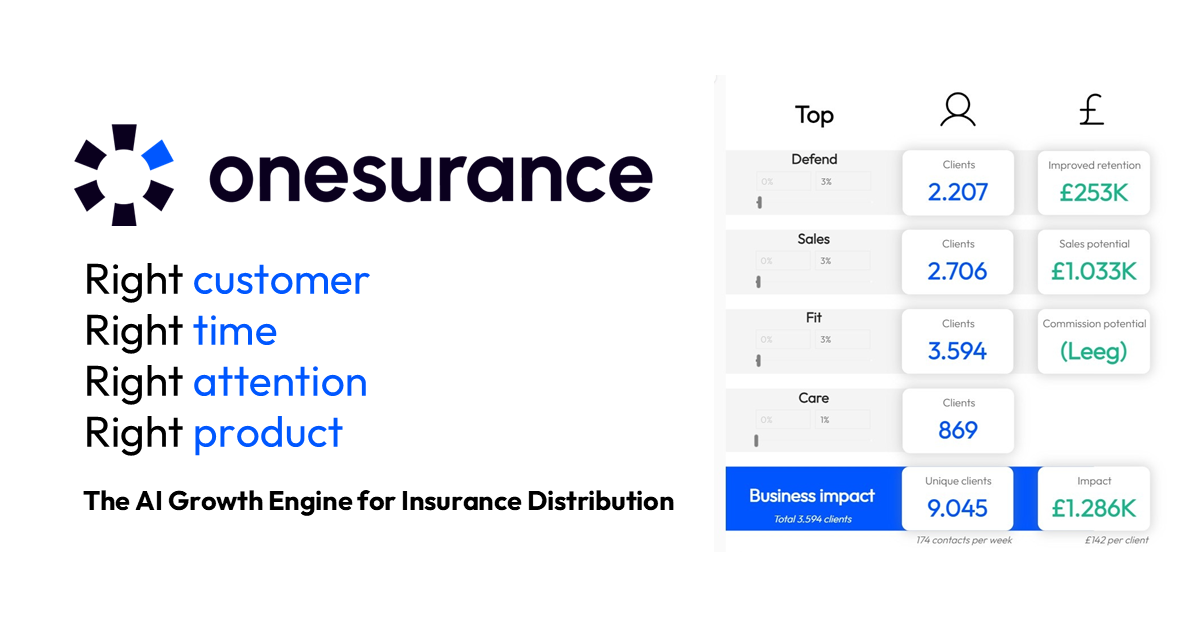
A mid-size commercial broker with EUR 45M in revenue and 12,000 active clients deploys AI across three use cases over 18 months. First, an automated renewal prioritization model analyzes client data, claims history, and market conditions to rank the upcoming renewal book by risk of non-renewal and revenue potential. Account managers shift from working renewals chronologically to working them by priority, increasing retention by 4 percentage points. Second, a cross-sell identification model analyzes coverage gaps across the client base, flagging 2,800 clients with incomplete protection programs. Targeted outreach converts 340 of these into new policies, generating EUR 1.2M in additional premium. Third, a claims triage system uses NLP to classify incoming claims by complexity and route them to the appropriate handler, reducing average handling time by 35%. Combined, these three initiatives drive 15% revenue growth in 12 months — achieved with the same headcount by redirecting effort from manual processes to client-facing activity.
Key Metrics
| Metric | Benchmark | Impact |
|---|---|---|
| AI adoption rate (brokers) | 25-35% have deployed at least one AI use case | Early adopters gaining measurable competitive advantage |
| ROI timeline | 6-12 months for well-scoped projects | Document processing fastest (3-6 months), underwriting models slower (12-18 months) |
| Productivity improvement | 30-60% per automated process | Measured in time saved per transaction or submissions per FTE |
| Accuracy gains | 15-25% reduction in errors | Fewer mis-classifications, better risk selection, more consistent pricing |
| Data readiness (industry average) | 45% of brokers have adequate data quality | Data preparation typically consumes 60-70% of project effort |
FAQ
Q: Where should brokers start with AI?
The most effective starting point is a high-volume, data-rich process where AI can deliver measurable results quickly. Three proven entry points are: renewal prioritization (predicting which clients are at risk and which represent the highest cross-sell potential), document processing (using NLP to extract key data from policy documents and loss runs, reducing manual data entry by 60-80%), and portfolio analytics (identifying loss trends, pricing gaps, and concentration risks). Start with one use case, prove the ROI within 90 days, and expand from there. Avoid trying to implement AI across all processes simultaneously.
Q: What is the ROI of AI in insurance?
ROI varies by use case and implementation quality, but well-executed AI initiatives typically achieve payback within 6-12 months. Document processing projects show the fastest returns (3-6 months, 60-80% reduction in manual processing). Predictive underwriting delivers 5-12 points of loss ratio improvement within 18 months — for a EUR 50M book, that translates to EUR 2.5-6M in improved results. Client retention models that reduce churn by 3-5 percentage points preserve significant recurring revenue annually. The key factor is not the technology itself but implementation quality: clean data, clear success metrics, and organizational commitment to acting on the outputs.