Apr 1, 2022
How to avoid post-merger arguments?
Jack Vos in VVP Special Mergers & Acquisitions 2022
It will not escape anyone's notice that mergers and acquisitions are a popular way to quickly gain more market share or achieve economies of scale or synergy. However, studies show that in 50 to 85 percent of cases, the intended benefits are not realized. By far the most frequently cited cause is a clash of corporate cultures. At the same time, management often does not know how to measure (differences in) corporate cultures, manage them more effectively and how to optimally integrate them into one new culture, so that the risk of failure of the often very large investment is drastically reduced.
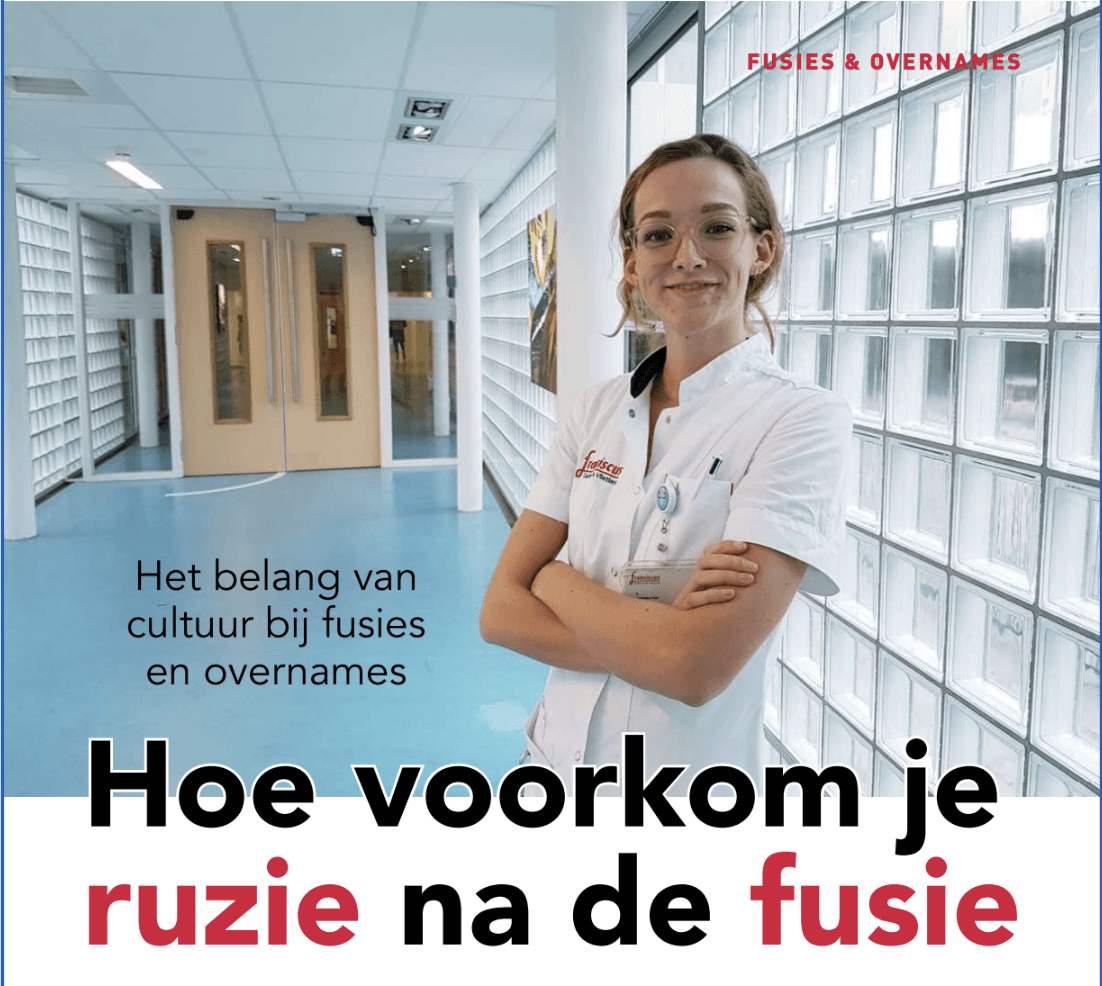
The two large hospitals Sint Franciscus Gasthuis and Vlietland Hospital merged in 2015 (six locations, over 4,500 employees, 250 physicians, 28,000 operations, 550,000 outpatient visits) in the challenging context of metropolitan Rotterdam-Rijnmond. Based on an employee values survey, the most desired value for the new merger organization emerged as "understanding. An eye for the person behind the medical complaint at a time when healthcare had hardened, led to the ambition that the new Franciscus should become the most understanding hospital in Greater Rotterdam. This resulted in a concept "Because we understand that... This concept was translated internally into (moving) images and with this the members of the Board of Directors first visited all departments. It turned out that employees were indeed very proud of the concept and the specially made video, which quickly went viral. Subsequently, training and coaching programs were designed accordingly: how do we create more understanding for each other, for patients and their loved ones? Even in the recruitment campaigns for new staff, people were no longer looking for just any doctor or nurse, but for colleagues who 'understand that...'. After seven years, this common thread - literally - in the form of the aspirational value "understanding" is still alive and well. The three-minute film can be seen here: https://youtu.be/m47ezdZLOwA Thethrust of management guru Peter Drucker's famous quote "Culture eats strategy for breakfast" is especially true for a growth strategy through merger or acquisition. Developing one corporate culture in a focused manner is already difficult, but when two or more cultures must come together, it becomes even more complex. Culture eats strategy for breakfast, operational excellence for lunch and everything else for dinner. The question is why in practice things so often go wrong and the merger leads to arguments with employees. Some causes with the open doors for improvement:
'Corporate culture is the sum of all the values and beliefs in an organization that determine how (well) we work together'
A merger or acquisition is a process and begins with determining a target company. In doing so, one looks primarily at revenue, customers, services or marketing power. Culture (mis)match is rarely one of the selection criteria and actually never a reason to turn down a deal.
- Then due diligence (literally due caution ) is conducted by accountants and lawyers. Experts who understand culture are not involved. Cultural due diligence is lacking because the assumption is that culture cannot be measured anyway.
- Further down the road, an increasingly uncertain, complex and ambiguous environment emerges for employees. Fear of the unknown paralyzes the organization, while workloads increase.
- The investment should preferably be recouped as quickly as possible. Financial pressures are also increasing; there is considerable attention being paid to costs. There is no money for the people side.
- People focus time and money primarily on the upstream such as optimization of processes and systems, merging offices or harmonization of working conditions. However, cultural problems from the undercurrent are becoming increasingly visible and also more difficult to solve. The damage has already been done.
- Culture development and integration is seen as a little project of HR for which there is (too) little budget and which is usually started too late. For employees, during the short information sessions, it feels like choke or swallow. After all, everything has already been decided anyway; they have not been asked beforehand what they think is important. They throw their butts against the manger or leave the organization; the best employees usually go first.
- There is much wrestling with when, to whom and especially how to communicate. However, the rumor mill does not stand still. Managers lack change management skills such as communicating proactively, showing understanding, appreciation and building trust.
Measuring Culture
To measure is to know and it is well known that things we measure tend to improve. The same is true of what you pay attention to in a company's culture. But how do we make culture measurable? First, a definition. According to Richard Barrett (founder of the ValuesCentre.com in the USA, a global authority on the subject), corporate culture is: the sum of all the values and beliefs in an organization, which determine how (well) we work together. Because it's very simple: the more shared values, the better people work together. Furthermore, values such as honesty, quality, innovation or independence are the intrinsic drivers of our ambitions and aspirations. All behavior is therefore values-driven. Values are universal; for Western Europe, the ValuesCentre uses a set of just 80 values that can describe all our behavior. With a Culture Values Survey (CWO) you measure which values employees find important and how to motivate them intrinsically, among other things by linking personal values to (desired) company values. Finally, even in very large organizations, you quickly create consensus on what is important and get everyone on board more easily.
How it works. In a CWO, all employees answer just three questions online; it is quick and easy to administer. The output of the CWO is a Top Ten most chosen values for both personal, current company values and desired company values (for the new merger organization). So these are bottom-up retrieved, most shared values. With this priority list, the MT must now work top-down. Preferably, one ambition value is distilled from the Top Ten. This is the merger value, or the key to success for the merger. Confidence increases because everyone's voice has been heard and one clear, ambitious guiding principle has been chosen.
Jack Vos: 'Positive impact on return on investment.'
With the CWO, you also measure which values are potentially limiting. These are values perceived by employees in the undercurrent, such as insularity, miscommunication, short-term orientation, cost reduction, hierarchy, etc., which can significantly hinder the merger. People feel this in the form of friction or frustration, but now it is measured explicitly. The sum of these potentially limiting values forms a percentage called cultural entropy. Benchmarks are available for this. Cultural entropy quickly rises to 30 percent on average during a merger/acquisition. For the CFO - who, by the way, is usually not the one interfering with culture - this means that 30 percent of the salary costs are spent on behavior that does not contribute to the goals of the (new) company. The measured impact of culture is thus translated into euros. Cultural entropy also indicates the upward potential of corporate culture: to what extent can we do more with the same people (instead of hiring new people).
'Culture in an organization is indeed measurable'
Culture and communication
With the CWO, objective conclusions can be drawn - if desired by department - about differences in culture, strengths, weaknesses, opportunities and threats. This is the input for a combined culture and communication program. Culture is about targeted interventions in the undercurrent that are determined together with HR. What skills, abilities and resources are needed in line with the ambition value or how and where are we going to lower cultural entropy? This program usually starts with the teams of the individual organizations getting to know each other, using the output of the CWO as a talking point. A dialogue about the shared values immediately creates connection. Leadership development is essential as is CEO sponsorship. At the same time, together with the marketing/communications department, a well thought-out concept with an appealing and distinctive image is devised around the ambition value. The concept is translated internally and externally into images, media and resources. It becomes the common thread for all communications and also determines, for example, what the layout of the office will look like.
Culture is never 'finished'
Experience shows that usually the people with "harder" rational values such as result orientation, organizational growth, profit or shareholder value are (and take) the lead in a merger/acquisition. They see the importance of culture less. Especially in the short term, people with 'softer' relational values such as customer satisfaction, trust or loyalty are then snowed under. However, these relational values are certainly very important for companies in business services for the long term. By making culture measurable and translating it into impact in Euros, it becomes easier to make rational people in the organization aware that more time and budget may be needed after all to develop a single, effective corporate culture. This is not a project, but a process that is never finished and requires a lot of patience. Of course, one can decide not to develop the corporate culture (in a targeted manner). Unfortunately, then a culture develops anyway and usually not in the desired direction. With the major risk being demotivated employees and very annoying, dissatisfied customers.
As a certified culture engineer, Jack Vos has extensive experience guiding companies in the area of culture.
Source: this article originally appeared in the VVP, read here the online article.