Oct 11, 2024
account managers algorithms? The opportunities and drawbacks of AI in consulting practice
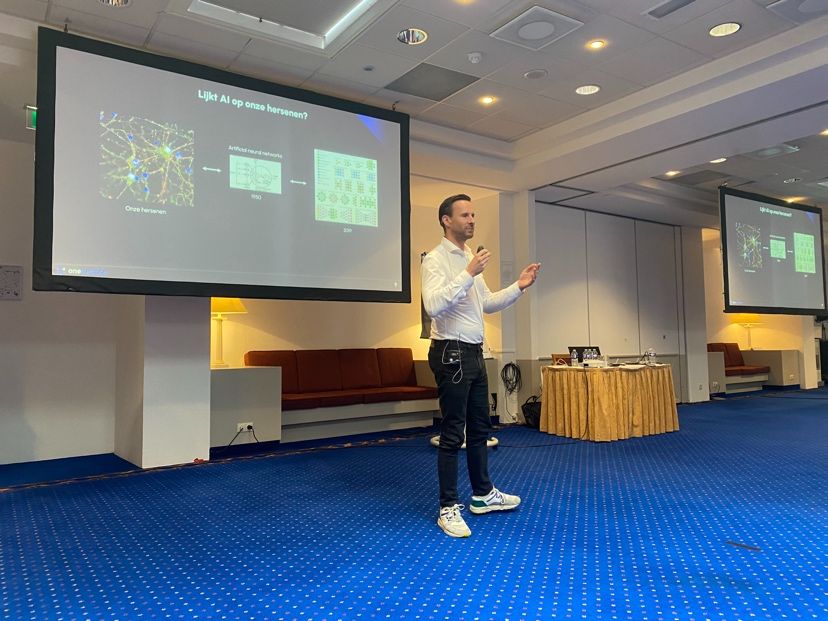
Our CTO and Co-founder Dennie van den Biggelaar gave an informative keynote on AI in insurance for 120 members of the Stichting Assurantie Registratie (SAR). There was a large turnout of advisors under the recognition schemes of RMiA, RGA and RPA.
Artificial Intelligence (AI) is all around us. While AI is lauded for its potential to replace human intelligence, it raises the question: will humans become obsolete in a world increasingly dominated by machines? This tension is particularly relevant in the insurance industry, where personal relationships and trust have been at the heart of advisory practices for decades. What does the rise of AI mean for insurance advisors, who until recently seemed indispensable? Dennie van den Biggelaar, co-founder and CTO of Onesurance.ai, explores how AI is transforming advisory practice and highlights the benefits as well as the challenges.
This article was originally published in the Scholarship Angel. See also the LinkedIn post we posted about it here.
"Insurers, proxy companies and intermediaries benefit from future-proof business operations. The use of data and AI is crucial in this," stated Van den Biggelaar. During the very well-attended SAR theme day on AI on May 15, 2024, he shared his insights and experiences on integrating AI in advisory services. He will also continue to share his knowledge in 2025 during PE sessions on AI for RMiAs and RGAs. Together with insurance veteran Jack Vos, Van den Biggelaar founded 2022 Onesurance.ai, a high-tech data science company that deploys AI specifically for insurance companies to increase effectiveness and efficiency. Dennie himself has more than 15 years of experience in the field of data science, which is now called AI. Onesurance 's efforts have not gone unnoticed: more than fifteen mostly large proxy companies as well as insurers in the Netherlands and Belgium already use their services. They recently raised a large investment from venture capitalist CuriosityVC, a professional fund that only invests in AI companies.
Retrospective
The development of AI has a long history. Van den Biggelaar explains: "As early as 1950, the foundation for AI was laid. Academics and researchers such as Alan Turing introduced the important question: can machines think? This led to the development of the Turing test, a measure to determine whether a machine can mimic human intelligence." He also mentions the victory of IBM's DeepBlue computer over Garry Kasparov, world chess champion, in 1997. "A historic moment: it was the first time a machine beat a human in a complex mind game like chess. Fourteen years later, IBM Watson won the famous television show Jeopardy! from human contestants. Once again, proof that AI is capable of performing complex tasks such as interpreting language and analyzing large amounts of information in real time." More recently, the emergence of powerful AI systems, such as the well-known ChatGPT in late 2022, has further expanded AI's capabilities. "These systems use advanced techniques such as deep learning, can mimic human conversations and generate content. This presents new opportunities for insurers to improve customer interactions and automate processes."
Active customer management
AI offers many benefits that can take the insurance industry to the next level, especially when it comes to improving customer management, efficiency and decision-making. "AI enables insurance companies to manage customer relationships much more effectively," said Van den Biggelaar. "For example, by using predictive analytics and machine learning, insurance companies can predict customer lifetime value and determine which customers are at high risk of termination (churn). Predictions that help advisors intervene proactively. For example, with personalized offers for customers at high churn risk, significantly improving customer retention. This is by no means future music; with the Onesurance AI Decision Engine we have been successfully supporting active customer management at several proxy companies since early 2023." This leads to increased efficiency and makes it possible to manage a larger customer base with the same number of employees. This is especially relevant at a time when the number of clients is increasing due to consolidations, but capacity cannot always grow proportionally.
AI can also help improve decision-making by processing and analyzing enormous amounts of data. “For example, AI models can be used to underwrite even complex policies. A good example is Dazure, for which we built an AI underwriting model that underwrites life insurance policies with 99.9 percent accuracy. The insured knows immediately whether the application has been approved, the insurer operate with far fewer underwriters, and it saves on unnecessary medical reviews. Those professionals have other work to do.” “Insurance companies don’t need to overhaul their entire system to reap the benefits of AI,” says Van den Biggelaar. “This makes implementing AI relatively simple and ensures that the benefits quickly become apparent in daily operations. The AI Decision Engine, for example, offers a fully integrated solution that uses both internal data and external sources to make better business decisions.”
Ethical standards
While AI offers many benefits for the insurance industry, there are also concerns and challenges to consider. "One of the biggest concerns is ensuring ethical standards," states Van den Biggelaar. "AI systems can make decisions that greatly affect customers, such as rejecting insurance or setting premiums. The risk here is that decisions are made based on biases or opaque algorithms. This can lead to unfair treatment. It is essential that AI systems be transparent and explainable so that customers and stakeholders can have confidence in the decisions AI makes. This is why custom-built systems are often preferred over GenAI systems such as ChatGPT."
He also warns against losing the human element in customer interactions. "The deployment of AI should always be balanced with human interaction. Insurance is eminently human. Trust and personal relationships are key. If you go too far with automation, it can lead to less customer satisfaction and loyalty. You have to use AI to support advisors, not replace them completely."
The barrier to adoption
Another challenge regarding AI is technical complexity. This can be a barrier for insurance advisors and clients, according to Van den Biggelaar. "AI models are often difficult to understand and explain. This can lead to a lack of trust in the technology. Especially if clients or employees do not fully understand the operation and outcomes. It is therefore crucial to implement AI applications in such a way that they are understandable and accessible. Give adequate attention to training and explanation," he stresses. At Onesurance , much attention is paid to education and communication about how the AI solutions they offer work. There is also a risk that companies rely too much on AI without sufficient human oversight. "This can be problematic. Especially in complex or exceptional situations, where human intuition and experience are indispensable. This is why it is important that AI systems are always supervised by human experts so that they can intervene when necessary. We call that the human in the loop." It is important to note that AI systems are not static. "You have to constantly monitor and adjust them so that they continue to perform as intended. This requires a significant commitment of resources and expertise, which can be challenging. Without adequate monitoring, AI can produce undesirable results over time, such as developing biases in decision-making or not being able to adapt to changing conditions."
account managers the future
AI has evolved from a theoretical concept into a practical technology that is already widely used in the insurance sector. The evolution of AI demonstrates how this technology is becoming increasingly integrated into our daily lives and business processes, while simultaneously creating new challenges and opportunities. “With the right approach, AI can indeed be an opportunity for account managers customers,” says Van den Biggelaar. He concludes with a call to the insurance sector: “It’s time to embrace and capitalize on the opportunities AI offers. Let’s work together to build a future where people and technology go hand in hand for the best results. Only then can we fulfill the promise of AI and take the insurance industry to the next level.”